A glimpse at some of the major projects the team members at Melius have supported......
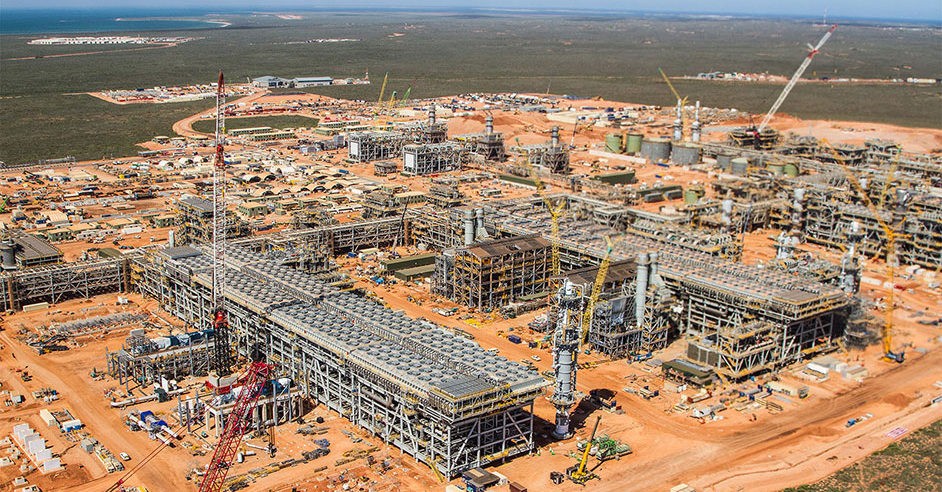 Chevron's Gorgon Gas Project -- Barrow Island, Austrailia -- $54 Billion LNG Plant Scope: Baseline & FollowUp Activity Analysis, Work Process Analysis and improvement (Materials Management)
.jpg) McDermott Middle East, Inc. Jebel Ali Fabrication Yard -- Dubai, UAE -- 131 acre yard executing 12 million labor hours per year Scope: Baseline Activity Analysis, Observer & Program Manager training, licensing of software system.
McDermott Middle East, Inc. Jebel Ali Fabrication Yard -- Dubai, UAE -- 131 acre yard executing 12 million labor hours per year Scope: Baseline Activity Analysis, Observer & Program Manager training, licensing of software system..jpg) Chevron's EGTL Project -- Escravos, Nigeria -- 34,000 bpd gas to liquids plant Scope: Baseline & FollowUp Activity Analysis
Chevron's EGTL Project -- Escravos, Nigeria -- 34,000 bpd gas to liquids plant Scope: Baseline & FollowUp Activity Analysis.jpg) P.T. McDermott Indonesia Fabrication Yard -- Batam Indonesia -- 297 acre fabrication yard executing 14 million labor hours per year. Scope: Baseline Activity Analysis, Observer & Program Manager Training, Tech Licensing
P.T. McDermott Indonesia Fabrication Yard -- Batam Indonesia -- 297 acre fabrication yard executing 14 million labor hours per year. Scope: Baseline Activity Analysis, Observer & Program Manager Training, Tech Licensing Southern Nuclear's Plant Vogtle Units 3&4 Project -- Waynesboro, GA -- $25 Billion Nuclear Reactors Project Scope: Baseline Actvity Analysis
.jpg) Reficar (Refineria de Cartegena) Expansion Project -- Increase capacity from 80,000 bpd to 165,000 bpd Scope: Baseline Activity Analysis, Observer & Program Manager Training, Tech Licensing
Reficar (Refineria de Cartegena) Expansion Project -- Increase capacity from 80,000 bpd to 165,000 bpd Scope: Baseline Activity Analysis, Observer & Program Manager Training, Tech Licensing
The team at Melius has over 3 decades of experience implementing Activity Analysison projects around the world. Activity Analysis was evaluated by the Construction Industry Institute (CII) and selected as a best practice as part of a 5 year study (2009-2014) on improving craft productivity on industrial construction sites around the world. Also referred to as "Work Sampling" or "Time on Tools Studies", Activity Analysis has been an effective tool in the construction industry for many years now. The goal of Activity Analysis is to optimize craft utilization efficiency. Craft utilization efficiency can be best defined as how well project management provides craft resources with the tools, equipment, material, and information they need when they need them. The procedures for data collection and analysis are executed over the course of several observation rounds. Observers take "samples" (visual snapshots) of craft labor and categorize their activity into one of several activity categories. Melius has its own set of category definitions but is flexible to adopt the clients' definitions if desired. The parameters of data management are guided by statistical rules, ultimately providing a statistically-valid assessment of project labor across many data sorts and slices. Performance is compared to similar jobs to help management prioritize improvement efforts. However, despite this longevity of using statistically-proven methods of supplementing your producrivity management efforts, there are ill-advised attempts at implementing Activity Analysis. As part of their final report, CII Research Team 252 also issued a training guide on self-implementation of Activity Analysis. While nothing in the training guide is incorrect, the information contained in the guide is limited by design, particularly with regards to the "do's" and "don'ts" and the different pitfalls that one may face when implementing Activity Analysis internally.
Melius consultants have experience conducting Activity Analysis on major industrial projects around the globe since 1989. Here are a number of client categories we have served in the past.....
- Mega-projects, large capital, small capital, maintenance and outages in the oil and gas industry.
- Capital projects and refueling/maintenance outages for nuclear and fossil fuel power plants.
- Capital projects (large & small), maintenance, and turnarounds for chemical and petrochemical plants.
- Projects of all sizes and scopes from virtually any industry will benefit from this analysis.
Though you never get to 100%, the objective of Activity Analysis is to maximize the craft workforce's Direct Work (hands on tools) during every Available Productive Minute (APM). So to study craft utilization efficiency, we start by defining how many and when APMs are on that particular shift.
Safety meetings, structured breaks including lunch, or any other management-mandated work stoppage reason are not included in activity observations. Those minutes are not available for craft to work so the data should not imply poor performance by including observations during those times. See the typical shift timeline above for an example of one of these exercises.
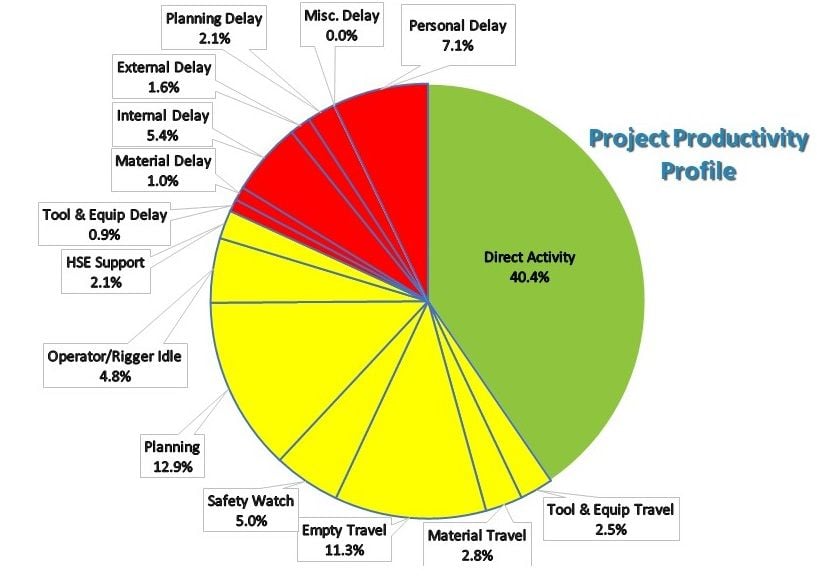
This means that reported activity percentages from the Melius team are calculated only including shift APMs. So for example if Direct Activity was reported as 50%, it means they are working half of the minutes allotted for production, not half the shift. In this case, 50% Direct Activity would be less than half the shift.
Because productivity won't be optimized during structured, non-productive times, there is no point in including those times in the project data set.
Prior to the team's arrival, with Melius guidance the client should implement a craft ID system, usually with colored tape keyed to each craft discipline. Following site orientations, the team will use the project plot plan to define study routes during walk-throughs with field supervision. Once Craft ID is confirmed, routes determined and communicated with the team, study orientations completed with field supervision and management, and finally the data collection technology has been set up and tested, the study is ready to begin in earnest.
Following the data collection period, the data is reviewed with the team, opportunities we call "Focus Areas" are identified and quantified to help the client priortize elements of their resulting action plan.
One of the advantages of using Melius is having access to its many years' worth of performance measurement in its database. This allows us to position your project along the various scales for each activity definition. There are over 200 projects in our database. As part of the project analysis, Melius will whittle those down to the few most comparable projects. From that data set we create ranges of performance (Best to Worst) from the performance levels we are seeing in each activity category. Below is an example of how your project would be compared to similar projects in our database. Seeing how other similar projects are performing helps to prioritize improvement efforts and optimize your return on investment.
.jpg)
Above: Typical Shift Timeline... Observations are only recorded during Available Productive Minutes. (APM)
.jpg)
The primary benefit of improving craft utilization efficiency is that it drives mechanical progress towards project completion. Regardless of workforce size or composition, improving craft utilization efficiency will always accelerate mechanical progress unless there are unusually high levels of rework on the project.

The Daily Cost of Craft Travel, typically the most egregious offender in a project's productivity profile.

Hourly analysis... a major tool of Activity Analysis is searching for any correlations in the data. In other words, when this category changes, what happens to this or other categories?

"Waterfall" or "Roller Coaster" chart. Visually expressive way of showing how much and when inefficiencies are happening during the shift.
.jpg)
Once the database is filtered down to the projects most comparable to yours, Melius will show you how you are performing versus those projects in each category. This information is very useful in prioritizing items in your subsequent action plan.
If Melius is performing Activity Analysis for you, our final report will contain a number of "Focus Areas". Focus Areas are those improvement opportunities on the project that Melius believes will position it best on any follow-up assessments which may or may not be conducted at some agreed upon date in the future. Improving a given project's profile is achieved through a post-study Focus Area Action Plan. This plan involves a set of reasonable and appropriate actions taken by the project team and their designees to improve upon the baseline results. The focus of the follow-up assessments are two-fold:
* Validate improvement from the baseline or previous follow-up assessment action plan.
* Identify the current focus areas the project can take on to further itself along that same comparison curve.
Send us an email at info@meliuspros.com to request a sample report or other relevant details about any Melius Activity Analysis Service.

The Power of Foreman Availablity
It's benefits are intuitive. Yet, the industry is only now coming to fully understand the value potential of maximizing its foremen availability to its craft workforce. Those in the construction industry have always understood the role of foreman and its importance to project success. So much so that contractors around the world spend hundreds of millions yearly on leadership training for these critical employees. There they learn how to be a better leader for safety, quality and productivity.
The problem is the role of the foreman typically takes them out of the work area and away from their crew a large proportion of the day. Meetings, getting material, chasing down approvals on a permit, or one of at least a dozen other reasons that may pull them away from their crew.....if they aren't with their crews, the project is not leveraging the training investments made to improve performance in those key measurables.
A former client project commissioned our team to conduct an Activity Analysis while concurrently assessing Foreman Availability. Assessing Foreman Availability adds no cost to the study but gives a different view on productivity that can reap large rewards for the project team. In this pilot study that included Foreman Availability the data showed a clear correlation between increased foreman availablity and higher performance levels in all three of the key project measurables.
- Results were compared to the 4 month window immediately preceding this 4 month effort.
- Productivity: 12.8% improvement in Project PF value
- Safety: Recordable injuries fell from 5 to 2, total incidents fell 14.5%
- Quality also witnessed a decrease in rework.

Services Offered in Activity Analysis
Foreman Availability Pilot Results

Trendline shows the intuitve conclusion that as foreman availablity goes up, these is a positive correlation in Direct Activity.
.jpg)
Similarly, as foreman availiablity go up, craft travel goes down.

Improving foreman availablity improves Direct Activity which drives the project towards completion and an improving TIC. (Total Installed Cost)

- Baseline Activity Analysis Studies
- Follow-Up Activity Analysis Studies
- Observer & Program Manager Training Modules
- Equipment Utilization Studies
- Self-Implemented Program Audit Service (Organic or CII (Construction Industry Institute) Inspired Programs)
- Advanced Work Packaging (AWP) Benefit Validation Studies
All services include Management and Foreman-level orientations if applicable.
Baseline and Follow-Up Activity Analysis Studies
If you need someone to come do a comprehensive 3rd party Activity Analysis, the team at Melius has supported projects from many different industries, scopes and project values.
After completing any required project orientations, the team will set up the study in week 1. This involves designing data collection routes that cover the workforce, calibrating the team on the routes and activity definitions, and orienting project management and field supervision if applicable.
Data collection will last between 3 or 4 weeks depending on project size and complexity. Finally, a week of analysis and presentation preparation. On the final day, the team leader will deliver a presentation to the project management team. Following demobilization, the team leader will develop and deliver a comprehensive final report of findings that the client can distribute to anyone at their discretion. While the presentation is geared towards the audience that has been involved with the exercise from the start, the final report is comprehensive enough it can stand alone to individuals who haven't been involved. It is advised to limit distribution of the presentation slides and wait for the final report before distributing outside the project team.
The key is to understand and attack the Focus Areas identified during the study. Improving those focus areas will have a direct and positive impact on all your productivity measurements.
Observer & Program Manager Training Modules
If a client is interested in implementing an internal Activity Analysis program, you won't find a better partner than Melius. We will train and calibrate your data collection and program management resources to ensure your program is delivering its potential.
Any delivered module will be customized to 100% align with the nomenclature of the client's site and/or Activity Analysis program.
Internal Activity Analysis Program Audits
For clients who are implementing or have implemented their own internal Activity Analysis program, Melius offers audit services to help remove bias and optimize the value you are receiving from your internal program. The Construction Industry Institute (CII) offers an internal guidebook for implementation. Melius procedures are aligned with their process and can offer other value-added variations to the effort, such as foreman availablity optimization.
Equipment Utilization Studies
The same sampling methodology used to perform Activity Analysis on construction labor can be adapted to apply to Equipment Utilization. The category definitions and management protocols are different so you can't manage the information the same way. For example, you are always striving for 100% direct activity for labor but if you do achieve 100% crane utilization, you definately do not have enough cranes.



AWP Value Validation Audits
Similar to our other audit offering, the purpose of the AWP Value Validation Audit is to help validate the value brought to the project through implementation of the Advanced Work Packaging (AWP) process. If possible, a quick summary audit is conducted before implementation begins to baseline non-AWP performance or if that's not possible, we will baseline your site from comparable project data inside our database containing over 200 projects.
Afterward, our team returns at an agreed-upon time to conduct a 2nd audit to see if AWP is delivering the employee utilization efficiency benefits it claims.
Most of the craft utlization benefits associated with AWP implementation is directly tied to increased foremen availability to their crews, so that perfomance element is analyzed in detail in an AWP Value Validation Audit.
.jpg)
Need advice on a specific issue?
Please ask us about any specific performance-oriented need you have. If we're not the right partner, perhaps we know someone who can bring value. It's all about improvement.